
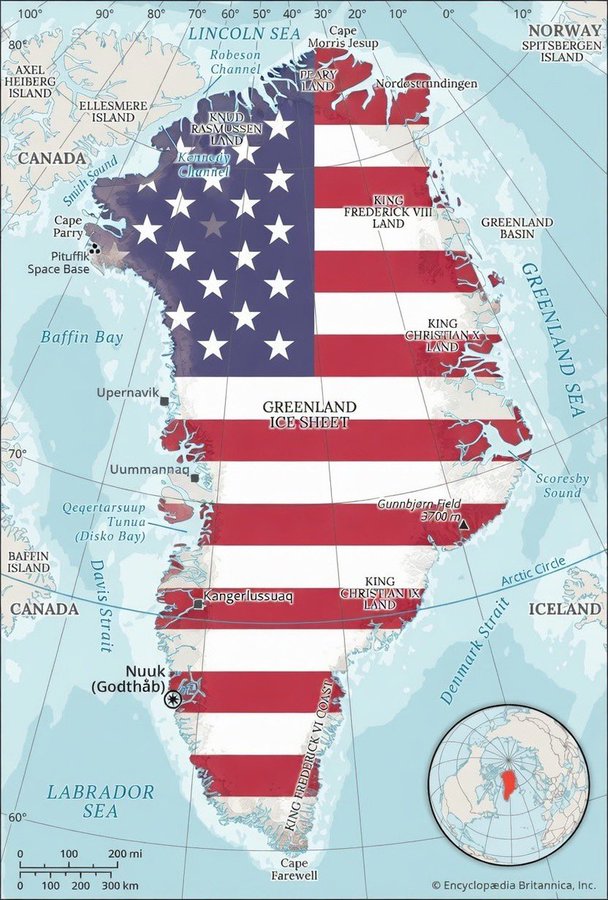
Hot on the heels of the U.S. military intervention in Venezuela and the extraction of the Maduros to face a U.S. indictment, attention turned to what might be coming next in the role out of the Trump Administration’s National Security Policy “America First” focus on the Americas. The discussion was made even more urgent when it was Trump and his team who were quick to wade into the issue and make suggestions themselves… Colombia, Cuba, Mexico and Greenland might be the next countries of U.S. expansion.
I want to focus on Greenland. I have personal connections to Denmark and Canada is, of course, right next door to Greenland. But I am mostly interested in the Greenland example because it illustrates very clearly the motivation behind U.S. threats to use military strength to “take it over” because it is important to U.S. national security. Indeed, it shows Trump’s motivation for what is always is…to act tough and to bully others for personal and political issues.
What makes the Greenland example interesting is that he does not have to bully anyone in this case. He just chooses to do so. Greenland’s history with the U.S., the various treaty commitments Denmark has with the U.S. with respect to Greenland and security, and the shared NATO membership of the parties would be more than sufficient for a diplomatic, mutually respectful negotiation to achieve anything that the U.S. could dream of wanting.
But rather than pursue this normal approach Trump has said on several occasions that he covets Greenland and must have it, including by way of military action. The most recent example of this was sparked by a tweet by an Administration staffer. Denmark, and Greenland were not amused. See Denmark PM bristles at Trump’s ‘need’ for Greenland after US strikes on Venezuela – POLITICO and Greenland slams ‘disrespectful’ pic posted by Trump aide’s wife.
The History is Important
For many, Greenland appears on the map as a vast, icy expanse with a tiny population and little geopolitical weight. Yet for the United States and NATO, this island of 56,000 people has been a strategic point for more than seven decades — a place where geography, alliance politics, and great‑power competition intersect with unusual clarity.
At the heart of things is a treaty: the 1951 Agreement on the Defense of Greenland, signed between the United States and Denmark at the dawn of the Cold War. Despite its age, the agreement remains the legal and political foundation for U.S. military activity in Greenland today. And as the Arctic re‑emerges as a theatre of strategic competition, the 1951 agreement is, and should be seen by the U.S. as, a key to their options in the North Atlantic.
The U.S. military presence in Greenland began not in 1951 with the signing of the Agreement on the Defence of Greenland, but in 1941. With Denmark under German occupation, Washington assumed responsibility for defending Greenland to prevent Nazi forces from establishing weather stations or airfields that could threaten North America. America built airstrips, weather stations, and early warning sites across the island — infrastructure that would prove important during the Cold War.
When NATO was formed in 1949, the alliance quickly recognized that Greenland’s geography made it essential to North Atlantic defence. Denmark, still recovering from the war and lacking Arctic military capacity, could not maintain the installations alone. The United States, facing a Soviet Union developing long‑range bombers and ballistic missiles, needed Arctic early warning capabilities.
The result was the 1951 Defense of Greenland Agreement, negotiated at NATO’s request and designed to integrate Greenland into the alliance’s collective defence architecture. The agreement is surprisingly broad. (read it here) For a history of the negotiations, from a Danish perspective, see Negotiating the 1951 Greenland Defense Agreement: Theoretical and Empirical Aspects
What the 1951 Agreement Allows
The Agreement authorizes the United States to:
1. Establish and operate “defense areas” in Greenland
These areas — the most famous being Thule Air Base (now Pituffik Space Base) — are U.S.-operated installations on Danish territory, created to support NATO defence requirements.
2. Control operations within those areas
While Danish sovereignty is recognized, the United States exercises operational authority inside the defense zones. This includes control over access, security, and day‑to‑day activities.
3. Move forces, equipment, and supplies freely for defence purposes
The agreement facilitates the transit and deployment of U.S. personnel and materiel, enabling rapid reinforcement or expansion of activities.
4. Expand or modernize facilities as required by NATO plans
This clause has allowed the U.S. to upgrade radar systems, build new infrastructure, and adapt to evolving strategic needs without renegotiating the treaty.
5. Conduct activities related to early warning, space surveillance, and Arctic operations
Although these missions were not envisioned in 1951, the agreement’s flexible language has accommodated the evolution of Thule/Pituffik into a critical node for missile warning and space domain awareness.
In practice, the agreement gives the United States a degree of operational freedom in Greenland that is unusual among allied territories — a legacy of Cold War urgency and Denmark’s limited Arctic capacity at the time.
The Political Landscape has changed…but not by much
Greenland’s political status has evolved dramatically since 1951. Home Rule was established in 1979, followed by Self‑Government in 2009. Today, Greenland controls most domestic affairs, while Denmark retains responsibility for defence and foreign policy — though always in consultation with Greenlandic authorities.
This creates an interesting dynamic that the U.S. would have to navigate.
• Denmark remains the formal treaty partner.
• Greenland expects meaningful involvement in decisions affecting its territory.
But surely such a context is not beyond the ken of U.S. officials to navigate. Especially as Danish and Greenland leaders, as NATO allies, increasingly view U.S. engagement as a counterweight to external interest from China and a source of economic opportunity, while Denmark sees U.S. presence as essential to Arctic security.
The Arctic is warming, opening new sea routes and intensifying geopolitical interest. Russia has expanded its Arctic military footprint, and China has declared itself a “near‑Arctic state” with ambitions in infrastructure, mining, and scientific research.
Against this backdrop, the United States, like all of NATO, is reassessing their Arctic posture — and Greenland is central to that effort.
The 1951 agreement gives Washington a suite of options that fall well short of any dramatic change in sovereignty but still allow for significant strategic enhancement. These include:
• Modernizing missile warning and space surveillance systems
• Expanding airfield capacity for Arctic operations
• Increasing rotational presence of U.S. forces
• Enhancing domain awareness across the North Atlantic and Arctic
• Investing in dual‑use infrastructure that benefits Greenlandic communities
Conclusion
In other words, the United States does not need new legal authorities to deepen its presence in Greenland. The framework for such expansion already exists. And as the Danes have already said, they are open to new negotiations. I would even imagine that they, and Greenland, would be prepared for negotiations around the mineral rights to Greenland’s resources that is surely part of the Trump play.
So why the focus on “taking over” the territory of a NATO ally with the use of military force? Psychologically it is probably related to the complete narcissist that Trump is and his need to bully others. Politically, it continues the approach suggested years ago…to flood the zone with so much shit that opponents have trouble reacting to it all. And let’s not forget his interest in seeing the Epstein scandal pushed off the front pages.
Let’s hope we don’t all suffer for it. The Atlantic has a good article on some of the implications that might be expected. See Taking Greenland Could Be the End of NATO – The Atlantic
Leave a Reply