
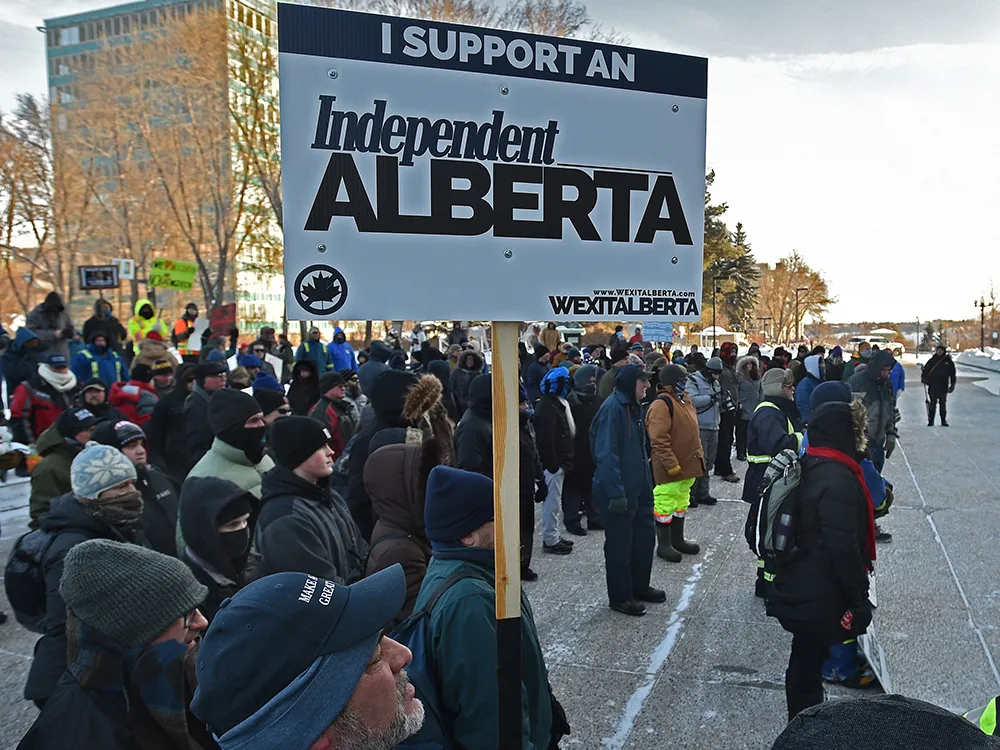
Canada has a separatist challenge… and its not Quebec… at least not yet. This time the issue arises in Alberta. Alberta Premier Danielle Smith announced recently that her government will add a new referendum question to Alberta’s October 19, 2026 provincial ballot, asking Albertans whether the provincial government should begin the legal process required to hold a future binding referendum on Alberta separating from Canada.
(I haven’t been tracking this on this blog…but will begin today. For those who want to dig in a bit on this issue this post includes a number of links to more detailed articles)
There has always been an fringe element in Alberta politics that has championed a “go it alone” vision. The Alberta version of Canadian separatism is based on some long-standing myths that various leaders have sown into the fabric of political debate in the province.
- The core complaint is that a number of Canada’s federal government policies (energy, emissions, and natural resources) systematically undermines Alberta’s prosperity. They point to federal emissions caps, clean‑electricity mandates, and restrictions on pipelines as evidence that Ottawa is deliberately constraining the province’s primary industry. Many believe these policies are crafted to appeal to voters in Central Canada at Alberta’s expense.
- There are grievances on the fiscal side as well. The argument goes that Alberta contributes far more to federal revenues than it receives in return, citing the Canadian system of “equalization payments” to provinces who are less well off economically at a particular moment as evidence that the policy redistributes Alberta’s wealth to other provinces while limiting its ability to develop its own economy.
- They also contend that Alberta lacks meaningful influence in national decision‑making, pointing to the structure of the Senate, the concentration of political power in Ontario and Quebec, and what they see as chronic disregard for Western concerns. It hasn’t helped that, Prime Minister Stephen Harper’s governments aside, Alberta has traditionally voted for conservative parties and has frequently not had many representatives sitting on the government side of the house.
- Culturally, separatists feel Alberta’s identity and priorities are misunderstood or dismissed by national institutions. Indeed, some Alberta separatists have co-opted some MAGA slogans and stylings
Taken together, these grievances lead some to conclude that independence—or a radically restructured constitutional arrangement—is the only viable path to protect Alberta’s economic future and political autonomy.
Those on the Canada side of the debate contend that Alberta separatism is based on a misdiagnosis of both Canada’s constitutional structure and the economic forces shaping the province’s future.
- They contend that Alberta benefits enormously from being part of a large, stable federation with shared currency, open internal markets, and national‑level fiscal capacity. From this perspective, separation would introduce economic uncertainty, capital flight, and trade barriers that would harm Alberta’s energy sector far more than federal regulations do.
- Many also argue that federal climate policy is not targeted at Alberta specifically but reflects global energy transitions and Canada’s international commitments. They note that Alberta continues to receive substantial federal investments in carbon capture, hydrogen, and energy diversification, and that Ottawa has repeatedly negotiated accommodations for Alberta’s unique energy profile.
- On the fiscal front, federalists emphasize that equalization is funded through federal taxes, not provincial transfers, and that Alberta’s net contribution status reflects its historically high income status rather than punitive design. They also argue that Alberta’s political influence is not marginal but significant—through cabinet representation, intergovernmental negotiations, and national party dynamics.
Put simply, the federal argument is that any move towards Alberta separation would be economically risky, constitutionally destabilizing, and unnecessary given the tools Alberta already has to assert its interests within the Canadian Confederation.
Various public policy groups are beginning to release analysis on the idea of Alberta independence. The most often cited is an analysis by Trevor Tombe who has detailed how a separate Alberta would be a poorer Alberta. Read Story The implication of Tombe’s argument, and one that I suspect we will hear more of given our current international context with President Trump, is that any move to an independent, and poorer, Alberta will have the effect of representing a surrender to a “51st State” outcome for Alberta in the longer term. As someone has termed it, a New Northern Montana.
This story already has had plenty of twists and turns…here are some of the backstories…
Alberta Premier Smith is facing attacks on her leadership from within her party. It has been suggested that she is quietly enabling the separatists in a effort to keep her job. Read Story and Read Story and Read Story.
Prime Minister Carney has called the Alberta move a “dangerous bluff” and has drawn links to the situation in the UK prior to Brexit. Read Story
The U.S. and Russia are said to have disinformation campaigns actively stirring up emotions on this issue. Read Story
A separatist group has used an Alberta electoral list improperly, resulting in a number of investigations Read Story. And electoral software they are using comes from the election denying faction in the U.S. MAGA movement and has been supported in the past by the current U.S. Ambassador to Canada. Read Story
First Nations people in Alberta have won in court that the Alberta government has denied them their constitutional rights. Read Story
Recent polling suggests that support for separation in Alberta lies around 30%, a level many compare to the UK before the Brexit process began. Read Story
The Guardian recently did a good job of summing things up.
See Echoes of Brexit as Alberta blunders towards vote on separation from Canada | Canada | The Guardian
So hold onto your hats…and add this to the list of things that PM Carney will have to deal with at the same time as he works to mitigate the various issues the U.S. government is pushing his way.
Leave a Reply