
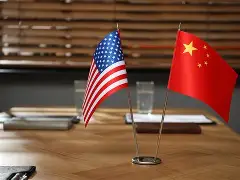
President Trump’s chaotic trade agenda with Canada, and other countries, is usually seen as being all about using tariffs as a lever with bilateral partners to relocate production to the U.S. and to leverage policy decisions that are in favour of the U.S. And that is certainly what it is designed to do. But it’s not all strictly bilateral.
I came across this very interesting Peterson Institute for International Economics article that took a look at some of the recent U.S. trade agreements from the perspective of how they are in many ways about constraining doing business with a third partner… China
US reciprocal trade deals built to push America’s trade partners away from China
Mary E. Lovely (PIIE) and Christine Y. Wan (PIIE) June 4, 2026
…The Agreements on Reciprocal Trade (ARTs’) fine print reveals, however, that they are far more significant than simple bilateral trade deals: They construct a legal architecture to pull US trade partners away from China and to constrain China economically. They push partners to keep supplying the US market, but on terms that reduce space in other countries for Chinese firms, capital, and technology, as well as China-linked transshipment. The United States is not simply reducing direct imports from China. It is setting a framework to mold global value chains around US strategic preferences…
…This approach may strengthen US leverage, but it also raises the question of how much policy autonomy partner countries are giving up in exchange. China could retaliate against them in many ways. Given the deep integration of many middle-income ART partners with China, especially those located in Asia, the agreements place them in a difficult bind: meet US demands and risk Chinese punitive measures or defy the United States and endure a snapback of the “reciprocal” tariff rates.
Read the full article here.
Leave a Reply