
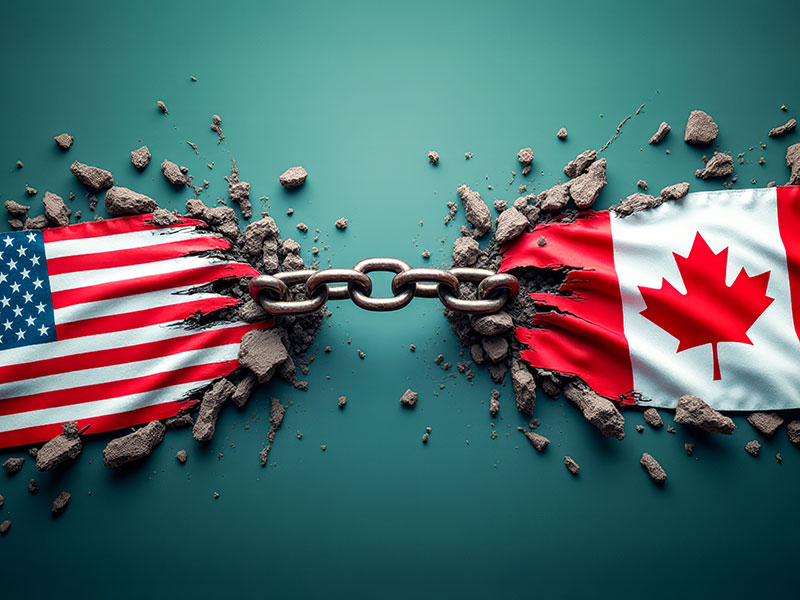
I found this opinion piece by Marc L. Busch and Barry Appleton to be useful in explaining some of the motivation behind Trump’s U.S. trade policy.
Trump is writing a most favored nation clause that nobody signed
by Marc L. Busch and Barry Appleton, opinion contributor – 08/28/26 10:00 AM ET
Trade agreements are bargains. President Trump seems to think the United States should get the benefits of other countries’ bargains. But if countries expect Washington to claim the best concessions later without paying for them, they have every reason to offer less in the first place, including to American negotiators.
That idea connects two unrelated fights with Brazil and Canada. In both, Washington objects that other countries give some trading partners better treatment than they give the United States. It increasingly calls that difference “discrimination”.
Start with Brazil. Brazil, independently and through Mercosur, has “partial scope” trade agreements with Mexico and India. Those lower tariffs on select products, meaning Mexican and Indian exporters sometimes pay lower Brazilian tariffs than their American competitors.
The U.S. Trade Representative made these “unfair, preferential tariffs” part of its Section 301 investigation of Brazil, complaining that Mexico receives preferences on more than 1,000 tariff lines and India hundreds more.
Partial-scope agreements sit awkwardly in the trading system, and Congress has long questioned whether they satisfy the World Trade Organization requirement that free trade areas cover “substantially all trade.” But Washington’s argument goes further, claiming that American exporters are disadvantaged because somebody else negotiated better treatment.
Now consider Canada. Canada has its own trade agreements. Under the Canada-European Union Comprehensive and Economic Trade Agreement, Europe negotiated preferential access for cheese. The United States negotiated a different dairy package under the United States-Mexico-Canada Agreement (USMCA).
Yet, in invoking Section 338 of the Tariff Act of 1930 against Canada, Washington has cited more favorable treatment for European cheese as evidence of discrimination against American commerce.
As Mona Paulsen has shown, even Section 338’s architects understood the limit that the United States cannot indefinitely claim whatever preference another country negotiated. And the recently collapsed U.S.-Canada negotiations reportedly foundered in part over an extraordinary U.S. demand concerning Canada’s future trade agreements.
Put Brazil and Canada together and a doctrine becomes visible: Washington is now using Sections 301 and 338 as a most favored nation clause its trading partners never signed.
Investment lawyers will recognize the concept. Bilateral investment treaties commonly contain most favored nation provisions. They promise American investors treatment no less favorable than third-country investors receive, and an American investor may claim better treatment subsequently granted to European or Japanese investors.
That might look like free riding. The country agreed to it. The most favored nation obligation was part of the original bargain. It could demand compensation, negotiate exceptions or refuse it.
That is not what is happening here. Brazil gives Mexico a tariff preference. Washington calls the resulting disadvantage unreasonable under Section 301. Canada gives European cheese preferential access, and Washington calls the difference discrimination under Section 338. Tariff threats then supply the enforcement.
This is retroactive most favored nation without consent. It is also free riding on concessions others paid for. Europe did not receive Canadian cheese access for nothing; it negotiated the Comprehensive Economic Trade Agreement and gave Canada concessions in return. Mexico’s preferences in Brazil reflect a reciprocal commercial bargain.
If Washington demands comparable treatment simply because American exporters face a competitive disadvantage, it gets the benefit without paying the negotiated price.
The postwar system has always held a tension between nondiscrimination and preferential trade, and the solution is settled. Most favored nation is the default, but qualifying free trade agreements can offer deeper preferences because their members undertake deeper reciprocal commitments.
The United States has benefited enormously from this exception. Mexican goods receive USMCA preferences that Brazilian goods do not. Washington does not automatically extend those benefits to countries complaining of less favorable treatment. Why should its trading partners?
If Washington wants the best treatment Canada later gives another country, there is a straightforward solution: negotiate for it. What Washington should not do is obtain through unilateral tariff statutes what it failed to obtain at the negotiating table.
That is a credibility problem as well as a free-rider problem. Why negotiate tariff schedules, exceptions and rules if Sections 301 and 338 can rewrite those bargains afterward?
The problem is especially acute if Washington now wants influence over Canada’s future trade agreements. That is less of a new idea than a widened one. USMCA already requires Canada to give notice before negotiating with a non-market economy, and lets any party terminate on six months’ notice. The August demand reached far beyond it, going from claiming the benefits of other countries’ bargains to controlling which bargains they strike.
Nor is this hypothetical. Washington’s Malaysia agreement requires consultation on any future agreement that could jeopardize American interests, a term never defined.
For decades, the United States told countries that preferential access had to be earned at the negotiating table. Trump’s doctrine is different: Give somebody else a better deal, and America may demand it too, or impose tariffs until you do.
That isn’t the conventional most favored nation, and it isn’t reciprocity. It is a most favored nation clause nobody signed, enforced by tariff threats.
Marc L. Busch is the Karl F. Landegger Professor of International Business Diplomacy at the Walsh School of Foreign Service, Georgetown University. Barry Appleton is interim director of the Balsillie Legal Advisory Centre at the Balsillie School of International Affairs and Co-Director of the Center for International Law at New York Law School.
Source: The Hill
Leave a Reply